

Annelida: The phylum annelida was first coined by LAMARCK (1801) (Gr., annulus – little ring + eidos – form) for the higher segmented worms.
There are around 16500 species included in the phylum Annelida. Appearence of metamerism represents their greatest Advancement, so they are called a Segmented worms. The unique characteristic of the phylum Annelida is metamerism. The body is divided into a number of similar parts. Each division or part of the body is known as somite or segments or metameres. The somites are arranged in a linear series. Externally the somites are differentiated by ring like grooves called the annuli. The internal segmentation is also complete and distinct and hence the coelom id divided by transverse septa.
Definition:
These are metamerically segmented, bilaterally symmetrical, true coelomate animals. Typically all annelids are provided with chitinous setae which are embedded in the pits of the skin.
Phylum Annelida – General Characters
- Annelida mostly aquatic, marine and fresh water, some are terrestrial burrowings or living in tubes, some are symbiotic, free living and some are parasite.
- Organization in which organs form the system.
- Body are triploblastic, bilaterally symmetrical, coelomate. Truly segmented worm’s body is externally as well internally divided by a number of rings or annuli.
- Body metamerically segmented, externally by transverse gooves and internally by septa intp a number of division, each division is called a segment, metamere or somit.
- Locomotion with chitinous setae or muscular parapodia.
- Digestive system is well developed and extracellular digestion.
- Alimentary canal is tube like, complete, extending from mouth to anus.
- Blood circulatory system is closed type.
- Respiratory pigment dissolved in plasma.
- Respiration through humid skin or parapodia or cephalic gills.
- Excretory system segmentally arranged nephridia.
- Nervous system consisting of one pair of cerebral ganglia (or brain) and a double nerve cord with a pair of ganglia in each segment.
- Sense organs are the organ of touch, taste buds, statocyst, photosensitive cells and eye with lens.
- They are hermaphrodite or unisexual.
- Development: Spiral cleavage and determinate type. If development is indirect then the name of larva is Trochophore.
Classification
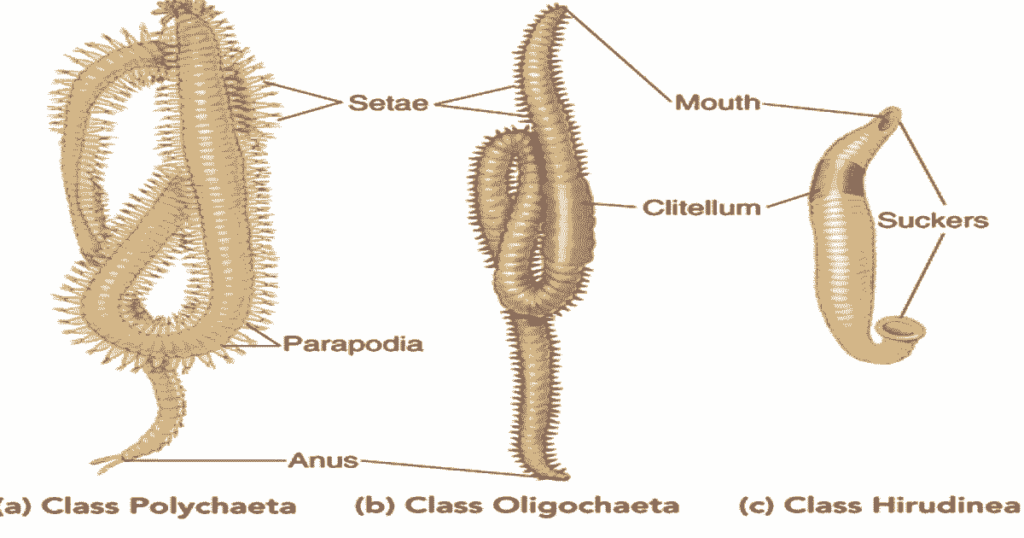
Class: Polychaeta (Gr., poly- many + chaite- hair)
- Mostly marine and carnivorous in nature.
- Distinct head with eyes and tentacles
- Segments with parapodia and lots of setae
- No clitellum
- Body Plan distinct head with mouth and sense organs
- Wormlike body with repeating segments body segments with flap like parapodia
- Head have distinct head. Head has retractable pharynx with jaws used to capture prey
- Chemoreceptors (nuchal glands) on palps and tentacles
- Touch receptors also on tentacles for locating food and shelter
- Three eyes are present. Some can focus an image to escape predators
- Most body segments have appendage with parapodia with setae
Example: Nereis, Aphrodite, Polynoe, Syllis, Chaetopterus, Terebella, Sabella etc.
Class: Oligochaeta (Gr., oligos- few + chaite- hair)
- Mainly terrestrial and some are freshwater
- Head absent
- Fewer setae, no parapodia
- Free-living; freshwater or terrestrial; usually fossorial (i.e., burrowing)
- Reduced cephalization with reduced sense organs
- Small setae on each segment aid in locomotion through substrate
- Detritivores in many ecosystems
- Fertilization external (in cocoon); development direct, no larval stages.
Example: Tubifex, Aelosoma, Pheretima, Eutypheus, Megascolex, Lumbricus etc.
Class: Archiannelida (Gr., arch- First)
- Exclusively marine forms
- Body is elongated and worm like
- Seate and parapodia are absent
- Usually hermaphrodite or unisexual
Examples: Polygordius, Protodrillus, Nerilla, Saccocirrus etc.
Class: Hirudinea (L., hirudo- leech)
- Mostly ectoparasitic, terrestrial, freshwater or marine
- No parapodia or setae
- Fixed no. of segments with “false segments”
- Anterior and posterior suckers
- Free-living predators/ectoparasites
- Coelom very reduced; body wall very muscular
- Salivary secretion “hirudin” is still sometimes used as an anticoagulant
- Many leeches are species specific, and many won’t feed on a human
- Hermaphroditic with one male and one female gonopore.
- Fertilization internal.
- Development in cocoons, direct without larval stages. (inside the cocoons )
Example: Acanthobdellida, Pontobdella, Piscicola, Branchellion, Hirudo, hirudinaria, Herpobdella etc.
