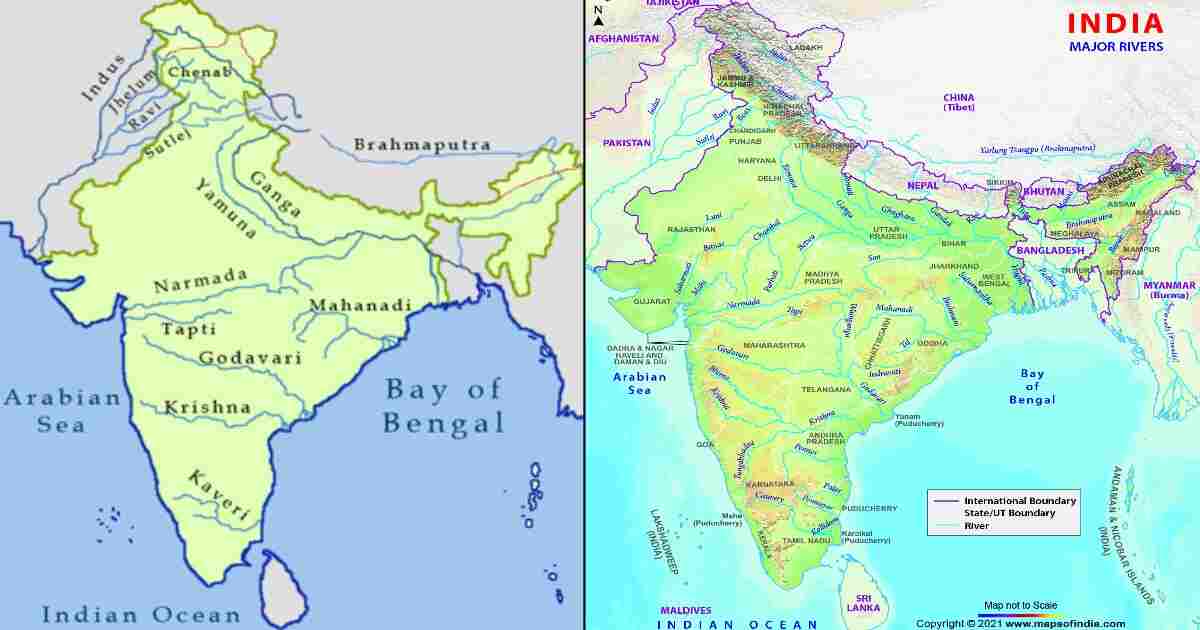
Brackish Water Fisheries: India is blessed with a vast inland water resources in the form of Freshwater resources (Rivers, man made lakes, ponds, streams etc) and Brackish water resources (estuaries, mangrove wetlands, brackish water impoundments). Brackish water is the newly created water bodies when the rivers meet to sea. Both water bodies are mixes where a particular ecotone or buffer zone are found therefore it is also called as estuaries.
Estuary: it may be defined as a water body in which river water mixes with seawater. Or the ecotone or buffer zone between freshwater of streams & salt water of the sea is called an estuary.
The water of the estuary is called brackish water just to distinguish it from the freshwater of river and marine water of sea. Estuarine area of India is about 9.47 lakh hectares. Largest estuarine area are found in West bengal -23.28% followed by Gujarat- 20.73% and Kerala- 15.74%
Ecological Characteristic of Brackish Water
- Estuary is the meeting place of river & sea
- It is a saline water
- It has shallow water & well oxygenated
- It is the ecotone of marine & freshwater habitat
- It is the river mouth but all rivers do not produce estuaries.
- The sediments carried by the river & accumulate at the river mouth
- Water level constantly fluctuates . During summer- less, Rainy – flow is high.
- During high tide more sea water enters the estuary & during low tide the sea water recedes.
- Salinity is fluctuates Summer season- high & rainy season – low, Low tide- low
- River mouth- 0.5-5.0% & Oceanic mouth- 25-30%
- PH- 7.5-8.3
- Fishes Inhibit in estuary according to their tolerance range of salinity there are three categories:
- Stenohaline fishes: it is the marine fishes inhabiting the river head
- Euryhaline fishes: it can tolerate salinity from 5-30% & regarded as the estuarine fishes.
- Oligohaline fishes: it is freshwater fishes, which can tolerate salinity upto 1% & inhibit the river head.
- Estuarine water bodies Upper layer is warm & lower layer is cold.
- Estuarine currents are formed by the interaction of flowing streams, oceanic tides & wind. The tidal action helps to mix the fresh & salt water
- By the current of water, the nutrients of estuary are repeatedly mixed in a vertical movement of water
- The mixing of sea & freshwater in a tidal estuary produces a horizontal two water layers come in contact
- Circulatory water brings the organic matter down the bottom & plant nutrients from bottom to surface to enhance productivity.
- Estuaries are located along the coastal area (East & west coast) of the country close to the entry of rivers in the sea.
 |
| Current pattern and Nutrition circulation in estuaries |
Biota of Estuaries – Brackish Water Fisheries
Brackish water fisheries are those that take place in bodies of water with a salinity level between fresh water and seawater. This typically includes estuaries, lagoons, mangroves, and coastal salt marshes. Brackish water fisheries are important for a number of reasons, including:
- They provide a source of food and income for millions of people around the world.
- They support a wide range of biodiversity, including many commercially important fish species.
- They play an important role in coastal ecosystems, providing habitat for birds, mammals, and other wildlife.
Biota of estuaries are classified into six main groups
Flora: phytoplnkton- cyanophyceae & chlorophyceae, macrophytes, sea weeds, marsh grasses etc.
Oligohaline organisms: It is a freshwater organism. They can tolerate salinity upto 1%.
Estuarine organisms: These organisms are found in estuaries hence it is true estuarine organisms, they adopt a wide range of salinity.
Euryhaline organisms: These organisms are marine and they extend their distribution from the sea to upper reaches of the estuary. It is an estuary biota. They can tolerate salinity upto 15%
Stenohaline organisms: These organisms live on open seashore and at the mouth of estuaries. They can tolerate salinity above 25%.
Migrants organisms: These organisms a part of life spent on estuaries these are- Diatoms, Protozoans, Coelenterates, Rotifera, Annelida, Arthropoda, Mollusca, Fishes, & Reptiles