Skip to content
Zoology Library Logo

Zoology Library

Zoology Library

  • Home
  • Biology
    • Zoology
    • Developmental Biology
    • SEC/VSC Cources
      • SEC Course on Microtechnique
      • Skill Enhancement Course on Haematology
      • Skill Enhancement Course on Urinology
      • SEC on Aquarium Fish Keeping
  • Economic Zoology
  • Fishery Science
  • Cell Biology
  • Conservation
  • Zoo Park & News
  • Web Stories
  • Toggle search form
  • National Zoological Park
    National Zoological Park, New Delhi Zoo Park & News
  • Captivating Wildlife at Indira Gandhi Zoological Park
    Discovering the Charm of Indira Gandhi Zoological Park in Visakhapatnam, Andhra Pradesh Zoo Park & News
  • Value Added Fish Products Fishery Science
  • Honey bee Species and subspecies
    Honey bee Species and subspecies Economic Zoology
  • ISRO’s Nabhmitra: Empowering Fisherfolk with Cutting-Edge Technology Fishery Science
  • Potential Scope of Aquarium Fish Industry as a Cottage Industry SEC/VSC Courses
  • Wild life week 2023
    Wild life week 2023 Conservation
  • Aquarium plants
    Aquarium Plants: Importance and Types SEC on Aquarium Fish Keeping

Torsion in Gastropods

Posted on October 6, 2025October 6, 2025 By Rajkumar Pawar No Comments on Torsion in Gastropods

Torsion in gastropods: It is a unique developmental process in which the visceral mass, mantle, and shell rotate 180 degrees counterclockwise relative to the head and foot during the larval stage. This causes the mantle cavity and anus to move from a posterior to an anterior position above the head, transforming the originally bilaterally symmetrical larva into an asymmetrical adult. The torsion typically occurs in two stages: an initial rapid 90-degree rotation caused by contraction of larval retractor muscles, followed by a slower 90-degree rotation due to differential growth.

Torsion in gastropods
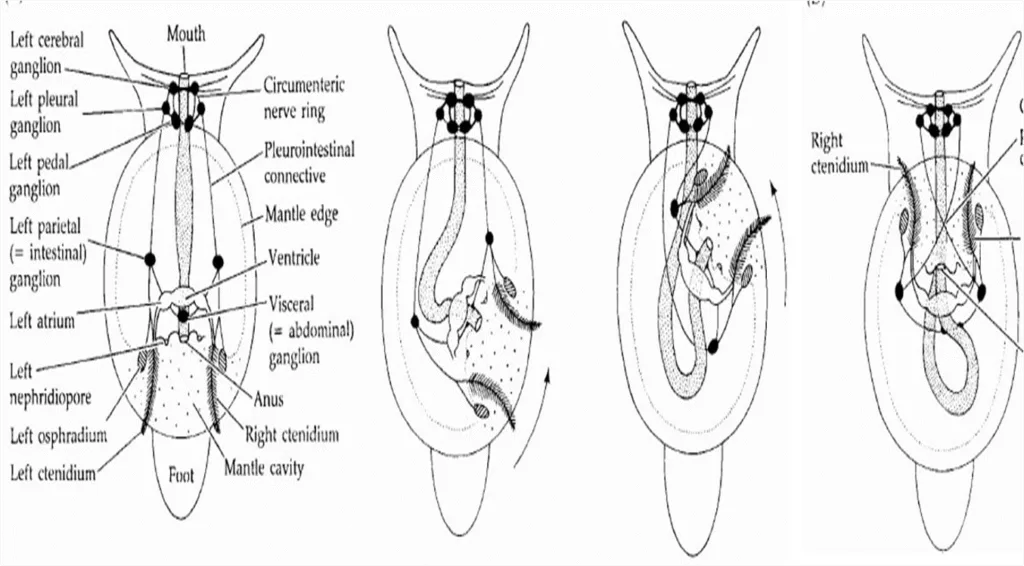
Torsion in gastropods

Torsion is the rotation of the visceral mass and foot 180 degrees with respect to the head and foot, and is a unique synapomorphy of modern gastropods. Torsion occurs during development in all gastropods, usually in the late veliger stage. However, some gastropods do not remain torted when becoming adults.

Effect of Torsion:

1. Position of organs in pre-torsional stage:

Posteriorly located mantle cavity opens backward; mouth and anus at opposite ends; ctenidia pointed backwards; auricles behind the ventricle; nervous system bilaterally sym­metrical; coiled visceral sac and shell dorsal or exo-gastric.

Position of organs in post-torsional stage:

Mouth cavity opens in front just behind the head; gut assumes U-shape; anus lies in front near mouth; ctenidia shifted to front, directed backwards, the right one shifted to the left and vice versa, the auricles become anterior to the ventricle and the position changed—right to left and vice versa; ner­vous system becomes twisted into a figure of ‘8’ by crossing of the pleurovisceral connectives; coil of visceral sac and shell become ventral or endogastric. ‘Torsion in gastropods‘

Significance of Torsion:

Author are in agreement that torsion is the result of a larval mutation but they do not agree on the advantage of such mutation restricted only to the larva or extends to the adult.

1. Due to torsion the mantle cavity be­comes anterior and the sensitive parts of the anterior end including the head and also the foot of the larva could be withdrawn into the mantle cavity at the approach of danger. Garstang (1928) holds that torsion represents a larval mutation, which is of advantage to the larva and not the adult, a concept shared by Yonge (1947).

By rotation the anteriorly placed mantle cavity provides a refuge for the delicate head and velar lobes of the larva, and it is not directly advantageous to the adult.

2. Morton (1958) believes the final effects of torsion due to larval mutation are pro­found in the adult snails though in a differ­ent way:

a. Torsion promotes stability in the adult by bringing the body of the snail nearer to substratum.

b. The free flow of respiratory water cur­rent in the posteriorly located mantle cavity containing the gills is obstructed by the back- flow of water current during upstream move­ment of the snail. In reverse situation, ante­riorly placed mantle cavity is continuously flushed with fresh water current. ‘Torsion in gastropods‘

c. The forward position of the receptors enables the snail to scan the surroundings and also test the quality of water and mud.

Read More : Phylum Mollusca

Biology

Post navigation

Previous Post: Ribosomes: Structure and Functions

Related Posts

  • Human Health and Disease Biology
  • Biological Significance of Some Invertebrate Animals Biology
  • Nephridia : Structure and Functions Biology
  • Phylum Chordata
    Exploring The Characteristic Of Phylum Chordata Biology
  • Animal Tissue: Structure, Types and Functions Biology
  • Pisces-General Characters and Outline Classification up to order level with Examples Zoology

Leave a Reply Cancel reply

Your email address will not be published. Required fields are marked *

  • Common Diseases in Aquarium Fishes SEC on Aquarium Fish Keeping
  • Bee Keeping Methods and Equipments Economic Zoology
  • Rotary and Rocking Microtome Uses, Precautions and Handeling Biology
  • Brackishwater Fishes: Characters and Classification Fishery Science
  • Hemichordata
    Hemichordata: Characteristic, Classification and Examples Zoology
  • Ponds for Hatching/Spawning of Fishes in India
    Ponds for Hatching/Spawning of Fishes in India Fishery Science
  • Wild life week 2023
    Wild life week 2023 Conservation
  • Rearing Pond and management
    Rearing Pond and Management Fishery Science

Categories

  • Biology
  • Cell Biology
  • Conservation
  • Developmental Biology
  • Economic Zoology
  • Fishery Science
  • SEC Course on Microtechnique
  • SEC on Aquarium Fish Keeping
  • SEC/VSC Courses
  • Skill Enhancement course on Haematology
  • Skill Enhancement Course on Urinology
  • Zoo Park & News
  • Zoology

Recent Posts

  • Torsion in Gastropods
  • Ribosomes: Structure and Functions
  • An Overview of Fisheries Development in India
  • Nucleus: Structure and Functions
  • Protochordata: Discovering the Characters and Classification with Examples

Pages

  • About Us
  • Contact Us
  • Disclaimer
  • Privacy Policy
  • Terms and Conditions

Copyright © 2025 Zoology Library.

Powered by PressBook News WordPress theme