
Scoliodon: The Scoliodon commonly known as the Indian Shark or Dogfish. Its body structure supports its cartilaginous nature as a member of the class Chondrichthyes. It is a predatory, fast-swimming lifestyle in the ocean.
External characteristics of Sccoliodon:
1. Shape, Size and Coloration
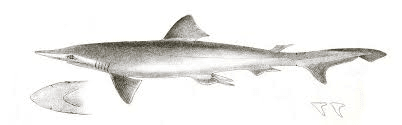
Scoliodon has an elongated, spindle-shaped body that tapers at both ends, typically measuring 30-60 cm in length. The trunk and tail are laterally compressed, while the head is dorsoventrally flattened with a blunt snout. The dorsal (top) surface is dark grey or slaty-black, while the ventral (bottom) surface is white or pale. This provides camouflage from both above and below.
2. The Head Region
The head is wedge-shaped and it bears the primary sensory organs:
Mouth: A crescent-shaped opening located on the ventral side. It is armed with several rows of sharp, backward-pointing teeth.
External Nares: Two nostrils located just in front of the mouth. They are purely olfactory (for smelling) and not used for breathing.
Eyes: Two large, lateral eyes. They lack true eyelids but possess a nictitating membrane (a third eyelid) for protection while hunting.
Gill Slits: Five pairs of lateral, oblique slits located behind the eyes. These are used for respiration.
3. Fins
Fins in Scoliodon are categorized into two types:
| Type | Fins Included | Function |
| Median (Unpaired) | Two Dorsal fins, one Anal fin, and one Caudal (tail) fin. | Stability and propulsion. |
| Paired | Pectoral fins and Pelvic fins. | Steering, balancing, and lifting. |
Heterocercal Tail: The caudal fin is asymmetrical. The vertebral column turns upward into the larger upper lobe. This design provides significant lift.
4. Skin and Scales
The skin is tough and feels like sandpaper because it is covered in Placoid scales.
Placoid scales consist of two main parts: a broad, rhomboidal basal plate embedded in the dermis and a trident-shaped spine projecting outward from the skin. The basal plate is calcified and anchored by connective tissue fibers like Sharpey’s fibers, while the spine includes one median and two lateral cusps directed backward. The inner basal plate has a pulp cavity for vascular supply.
Function: They reduce turbulence and act as a protective “armor.”
5. Sensory Systems
Lateral Line: A faint longitudinal line running along each side of the body. It contains mechanoreceptors that detect vibrations and pressure changes in the water.
Ampullae of Lorenzini: Tiny pores on the snout that can detect weak electrical fields emitted by prey.
6. Body Aperture
Five gill slits per side lie behind the eyes for respiration. A cloacal aperture between pelvic fins serves anus, urinary, and genital functions; abdominal pores and a lateral line canal with ampullary pores are also present.
6. Sexual Dimorphism
You can easily tell the difference between males and females:
Males: Possess a pair of rod-like intromittent organs called claspers attached to the inner edges of the pelvic fins.
Females: Lack claspers.
