
Agnatha: It is superclass of jawless fish that represent some of the earliest vertebrates. The term “Agnatha” comes from Greek, meaning “without jaws.”
Agnatha, (Ancient Greek ‘without jaws’) is a superclass of jawless fish in the phylum Chordata, subphylum Vertebrata, consisting of both present (cyclostomes) and extinct (conodonts and ostracoderms) species. Among recent animals, cyclostomes are sister to all vertebrates with jaws, known as gnathostomes.
General Characteristics of Agnatha:
- One of the most defining features of Agnatha is the absence of jaws. Instead, they have a round, sucker-like mouth that they use to feed.
- They do not have bones but instead have a skeleton made of cartilage.
- Agnathans lack paired fins (pectoral and pelvic), which are typically found in most modern fish and other vertebrates.
- They typically have a single nasal opening.
- They have elongated bodies, which are somewhat eel-like in shape.
- The heart is typically a simple two-chambered structure, unlike the more complex hearts found in higher vertebrates.
- Agnathans have gills for respiration, and these gills are often more primitive than those of jawed fish.
- Some Agnathans are parasitic (e.g., lampreys), attaching to other fish and feeding on their blood, while others feed by scavenging or preying on smaller organisms.
- They generally exhibit external fertilization, with the female releasing eggs and the male releasing sperm into the water.
Classification of Agnatha:
Vertebrates (subphylum Vertebrata) are generally classified into two groups: the Agnatha (jawless vertebrates), and the Gnathostomata (jawed vertebrates). The latter group includes fish with hinged jaws and the tetrapods (amphibians, reptiles, birds, and mammals). Agnatha includes the modern day lampreys (Petromyzontiformes) and hagfish (Myxiniformes) as well as several extinct orders. The superclass Agnatha is classified into two classes namely, Ostracodermi and Cyclostomata
Ostracodermi
Ostracodermi refers to an extinct group of jawless vertebrates that lived from the Ordovician to the Devonian period, roughly 485 to 359 million years ago. These early fish-like creatures were among the first vertebrates, but they are now known only from fossil remains.
Key characteristics of Ostracodermi include:
- Jawless: They did not have jaws, unlike most modern vertebrates.
- Body Armor: They were often covered in bony plates or scales for protection.
- Lacked Paired Fins: They did not have the paired fins (like those seen in modern fish) but had unpaired fins that helped in swimming.
- Filter Feeders or Detritivores: Some species likely filtered plankton from the water, while others might have consumed organic debris.
Ostracoderms were diverse and represented several different groups, with some having more primitive characteristics while others were more advanced for their time. They played a significant role in the early evolution of vertebrates before being largely replaced by jawed fish in the later Devonian period.
Cyclostomata
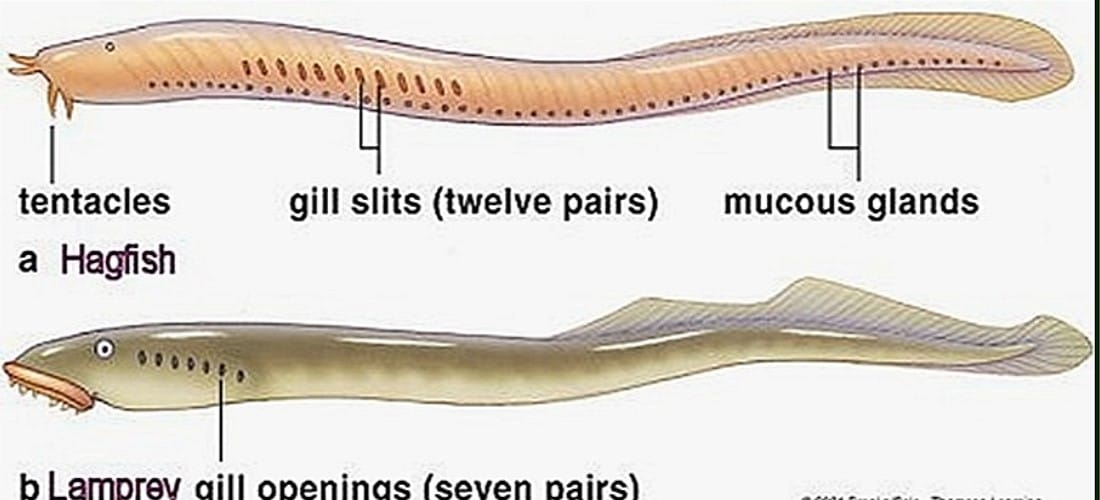
Cyclostomata is a class of jawless fish that includes the lampreys and hagfish. These are the only surviving groups of jawless vertebrates today. The name “Cyclostomata” comes from the Greek words “cyclos” (circle) and “stoma” (mouth), referring to the circular, sucker-like mouths that are characteristic of these animals.
Also Read: Phylum Chordata
Here are some key features of Cyclostomata:
- As with other jawless vertebrates, cyclostomes lack the jaws that most modern vertebrates possess. Instead, they have a circular mouth or sucker adapted to their feeding habits.
- Cyclostomes typically have a cartilage-based skeleton, rather than a bony one, which is more primitive compared to the skeleton of modern fish.
- Their spinal cord is simple, and they lack a vertebral column (though they have a notochord in the early stages of development, which serves a similar function).
- Many species of lampreys are parasitic, using their sucker-like mouths to latch onto the sides of fish and feed on their blood and tissues. Some lampreys, however, are non-parasitic and feed on organic matter.
- Hagfish are scavengers, feeding on dead or decaying fish. They use their tooth-like structures to tear apart the flesh of their prey.
- They have a simple heart and a closed circulatory system, similar to that of other vertebrates.
- Cyclostomes reproduce sexually, and most species are known to have external fertilization. Some species of lampreys, for instance, have a complex life cycle involving both marine and freshwater habitats.
- Cyclostomata are considered some of the most primitive living vertebrates, sharing many characteristics with early vertebrate ancestors. They serve as an important link in the evolutionary history of vertebrates, as they retain many features thought to have been present in the first vertebrates.
In summary, Agnatha are an ancient, jawless group of fish that include two main classes: lampreys and hagfish. They provide valuable evolutionary information about the transition from primitive vertebrates to the jawed fishes (gnathostomes) and other higher vertebrates.