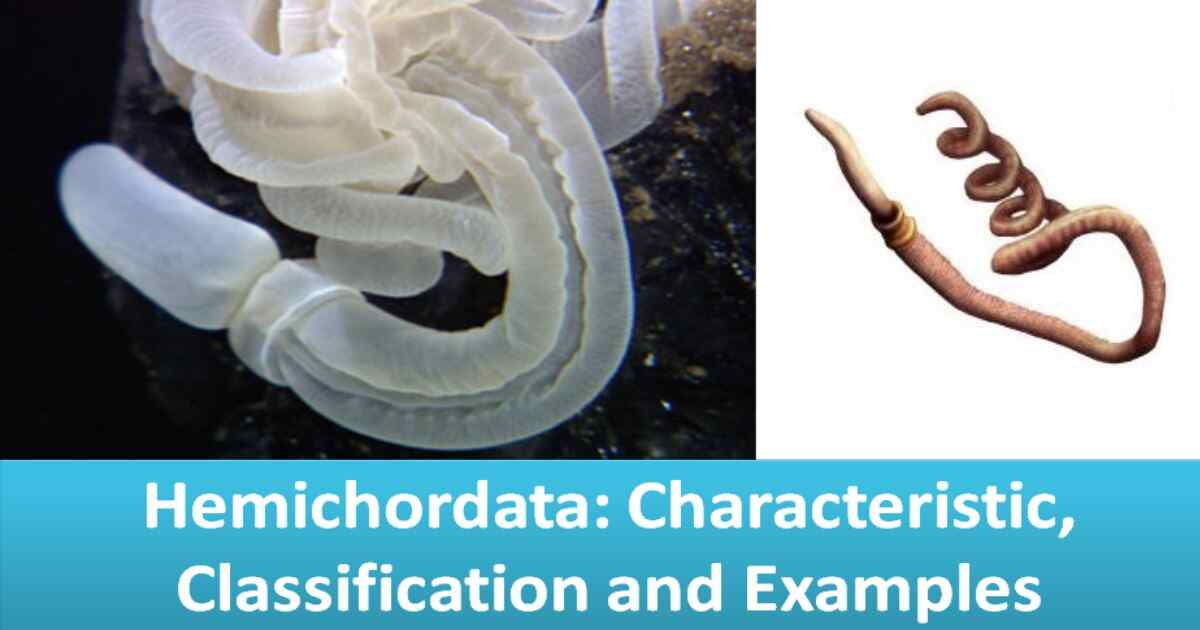
Hemichordata: They are tongue worms, which have been included for long as a subphylum or class of Phylum Chordata in the lower chordates or Protochordata, but now they are placed as an independent phylum of invertebrates, since their supposed affinities with chordates are doubtful.
Hemichordata are a small group of marine, solitary or colonial, worm-like, enterocoelous animals, most of which live in tubes. The soft, fragile body breaks readily in collecting. The body and enterocoelous coelom are divisible into three unequal regions, viz., proboscis, collar and trunk. In most forms one to several pairs of gill-clefts lead from the pharynx to the exterior. Nervous system is a network of nerve cells and fibres on the surface of the body, embedded in the epidermis. They have no bony tissue, but a buccal diverticulum is present in the preoral region, which is often regarded as a notochord, there is no tail. Development is direct in some, while in others there is a tornaria larva. The phylum has 100 species.
Definition
Usually vermiform, solitary or colonial enterocoelous coelomate animals with intra-epidermal nervous system and a pre-oral gut with or without gill slits and without typical nephridia.
Phylum Hemichordata: Characteristics
- Hemichordates are exclusively marine animals, found in ocean habitats.
- They can be solitary or form colonies.
- Their body is soft, fragile, and vermiform (worm-like).
- The body is bilaterally symmetrical and triploblastic (having three germ layers).
- It consists of three main parts: the proboscis, collar, and trunk.
- The body wall has a single-layered epidermis with mucous glands, and there is no dermis.
- The coelom (body cavity) is enterocoelous, divided into protocoel, mesocoel, and metacoel.
- A buccal diverticulum, once considered the notochord, is present in the proboscis.
- The alimentary canal is a straight, complete, or U-shaped tube.
- When present, dorso-lateral pharyngeal gill-slits aid in filter feeding.
- Hemichordates have a simple, open, and well-developed circulatory system with a dorsal heart and two longitudinal vessels.
- Excretion occurs through a single glomerulus situated in the proboscis.
- Their nervous system is primitive, consisting mainly of a subepidermal nerve plexus.
- Reproduction is mainly sexual, with separate sexes. External fertilization occurs in seawater.
- Development can be direct or indirect, involving a free-swimming tornaria larva.
Examples of hemichordates include: Balanoglossus, Saccoglossus, Rhabdopleura, Atubaria, and Dendrograptus
Phylum Hemichordata: Classification
The phylum Hemichordata classified into four classes.
Class 1. Entropneusta (commonly called “acorn” or “tongue worm”)
- They are solitary and burrowing worm-like marine animals.
- Body consists of proboscis, collar and trunk; collar without tentaculated arms.
- Alimentary canal straight; mouth and anus at opposite ends.
- Numerous pairs of U-shaped gill-slits.
- Two pairs of hepatic caeca present in the middle of the trunk.
- Sexes separate; gonads numerous, sac-like.
- Development with or without tornaria larva
Examples: Balanoglossus, Saccoglossus, Ptychodera
Class 2. Pterobranchia
- Sedentary, solitary or colonial, tubicolous marine animals.
- Proboscis with ciliated tentacles to produce ciliary feeding currents of water.
- Collar with two or more tentaculated arms bearing tentacles.
- One pair of gill slits or none, never U- shaped.
- Alimentary canal U-shaped with dorsal anus situated near the mouth at the same end.
- Sexes separate or united; single or one pair of gonads.
- Development direct, May or may not include a free-swimming larval stage.
- Asexual reproduction by budding in some.
order 1. Cephalodiscida
- Solitary or several individuals living unconnected in a common gelatinous house.
- Collar with several tentaculated arms.
- Gill-slits single pair.
- Gonads single pair.
Examples: Cephalodiscus, Atubaria.
Order 2. Rhabdopleurida
- Colonial, zooids connected by a stolon.
- Collar with two tentaculated arms.
- Gill-slits absent.
- Gonad single.
Example: Rhabdopleura (Single genus).
Class 3. Planctosphaeroidea
This class is represented by a few small rounded, transparent and pelagic larvae, supposed to be specialized tornaria of some unknown hemichordate Planctosphaera pelagica. The larva has branching arbores- cent ciliated bands on the surface. The alimentary canal of larva is U-shaped. The adult form is yet unknown.
Class 4. Graptolita
These are extinct colonial hemichordates, mainly known from the fossil structures of their tubes. Each animal is housed in a zooid. These were abundant in the Ordovician and Silurian periods. Example: Dendrograptus