


Higher Education: The Union Cabinet has approved the Higher Education Commission of India (HECI) Bill, now renamed as the Viksit Bharat Shiksha Adhikshan Bill (VBSAB).
This is a structural reset.
India’s higher education sector is undergoing significant reforms in 2025, primarily driven by the National Education Policy (NEP) 2020 implementation and new legislative proposals. Key changes aim to enhance flexibility, quality, and global competitiveness. These updates build on ongoing efforts to replace outdated regulatory bodies.
Viksit Bharat Shiksha Adhishthan Bill
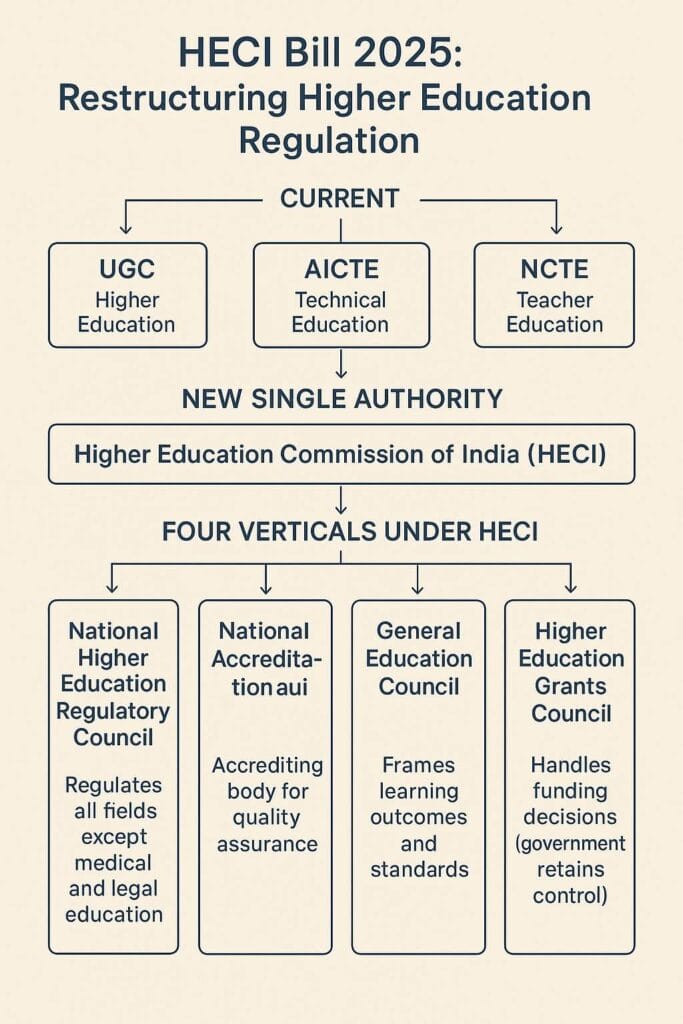
The government plans to introduce the Viksit Bharat Shiksha Adhishthan Bill, 2025, which will replace regulators like UGC, AICTE, and NCTE with a single apex body. This includes a Standards Council for academic synchronization, a Regulatory Council as the common regulator, and an Accreditation Council for oversight. The bill shifts focus from control to performance-based standards.
Higher Education Commission of India (HECI)
HECI introduces councils like the National Accreditation Council (NAC) emphasizing outcomes over infrastructure, Higher Education Grants Council (HEGC) for performance-linked funding, and General Education Council (GEC) for curriculum aligned with global frameworks. Reforms feature blockchain-secured certificates, AI monitoring, and Regional Education Excellence Centres. Foreign universities can now establish branches for greater access.
NEP 2020 and UGC Reforms
Flexible degree durations (3-4 years UG, 1-2 years PG), multiple entry-exit options, and the Academic Bank of Credits enable mobility and credit transfers. Programs integrate AI, biotech, and vocational skills with interdisciplinary learning. Gross Enrolment Ratio targets 50% by 2035 through industry linkages and research focus.
What it means in plain language:
UGC will be dissolved.
AICTE will be dissolved.
NCTE will be dissolved.
PCI will be dissolved.*
So yes, the old chairmen era ends.
No UGC Chairman.
No AICTE Chairman.
No NCTE Chairman.
No PCI Chairman.
Two clear exceptions:
Medical education stays outside, under NMC.
Law education stays outside, under BCI.
Everything else comes under one umbrella.
Now the new structure.
There will be one national Chairperson at the top level under VBSAB.
And there will be four councils, each with its own head.
- NHERC (National Higher Education Regulatory Council)
Approvals, permissions, compliance, entry and closure. - NAC (National Accreditation Council)
Accreditation, institutional quality grading, credibility. - HEGC (Higher Education Grants Council)
Funding rules, eligibility frameworks, performance-linked grants. - GEC (General Education Council)
Academic standards, learning outcomes, credit systems like ABC.
Regulation is separated from accreditation.
Accreditation is separated from funding.
Funding is separated from academics.
Now the biggest accreditation shift:
NAAC will be dissolved as an independent body.
NBA will be dissolved as an independent body.
Both will be absorbed inside NAC.
So no separate NAAC Chairman.
No separate NBA Chairman.
But inside NAC, discipline verticals will exist.*
Under the new system:
Engineering
Pharmacy
Architecture
Management and Business Schools
Hotel Management and other professional programmes
All these programme-level accreditations will continue under NAC through discipline-specific verticals.
For engineering, the accreditation vertical will remain aligned with the Washington Accord.
Outcome-based education will continue.
Score-based accreditation will continue.
The same NBA-style programme accreditation logic
will continue for other professional disciplines as well,
only now within NAC, not as separate councils.
Institution Level Accreditation itself will now run in two steps.
Step 1: Binary Accreditation
Accredited.
Not Accredited.
Step 2: Maturity-Based Graded Levels (MBGL)
Level 1: Emerging
Level 2: Developing
Level 3: Established
Level 4: Advanced
Level 5: Global readiness
Now the real disruption.
Most audits that earlier depended on files, visits, and discretion
will become technology-driven.
Level 1 accreditation will be fully digital.
No physical visits.
No physical inspections.
Data and dashboards.
This will make opacity difficult.
Manual discretion harder.
And the system more transparent.
Publically Available.
Funding will also change:
HEGC will define the rules and protocols for funding.
Funds will be released by the Ministry of Education.
A steep learning curve is coming.
For institutions.
For leaders.
For faculty.